3/7/18

The Three Steps for Successfully Integrating IoT into your Food Processing Factory

The three main steps for integrating IoT into your food processing factory are looking for quick wins, creating a roadmap for success, and being ready to fully embrace change.

No items found.
The Three Steps for Successfully Integrating IoT into your Food Processing Factory


Data-driven companies are the ones blazing trails in today’s markets, and everyone wants a piece of the IoT pie. But far too often an overzealous push to convert to IoT will result in failure and no or only partial implementation. The secret is to start slow, follow a plan, and change flexibly. By following the three steps of transformation, a company can ensure a successful move to data-driven management in your food processing factory.


1. Look for Quick Wins

It’s important not to rush in when fundamentally changing a company’s structure. Instead, pilot programs can be used as a proof of concept to show the benefits of IoT on productivity. To achieve this, the chosen cases should have a high chance of success, give rapid returns, and be highly visible to upper management. To achieve this, companies should choose easy-to-implement projects that are unobtrusive to other functions.

2. Create a Roadmap to Success

When the pilot projects prove successful, it’s time to begin planning for the future. At this stage, high priority use cases can be identified for conversion, and further implantation can be slated on all company levels. The company can begin to invest more in industrial analytics in preparation for the transformation and look at industry best practices to emulate.


3. Fully Embrace Change with IoT 

As the switch over to IoT begins to affect all levels of the company, new position, procedures, and policies must be established. The necessary data management and analysis positions must be created, guidelines on data formatting must be enforced, and the proper structure to handle and organize all the new data must be put into place. Finally, a flexible company structure can be implemented, with specialized teams to tackle problems in the now fully integrated, data-driven company.

Want to learn more about IoT the three steps? Find the full article here and download the Worximity e-book here.    
Want to learn more?
Download the ebook
Related blog articles

Related articles

Back to the blog
Thank you! Your submission has been received!
Oops! Something went wrong while submitting the form.
No items found.

Related articles

Back to the blog
Thank you! Your submission has been received!
Oops! Something went wrong while submitting the form.
Hand interacting with a futuristic digital interface displaying “2024,” AI icons, and technology symbols, representing emerging technology trends, artificial intelligence, digital transformation, innovation, and future-focused business strategy.
9
Jan 2024

Manufacturing Trends to Lookout for in 2024

As we look at manufacturing trends for 2024, pressure to stay on top of current trends and maintain competitiveness are at an all-time high

English
Automated bottling and packaging line in a manufacturing facility, with glass bottles moving through production equipment, representing production throughput, manufacturing output, operational efficiency, and process performance.
5
Dec 2023

Understanding takt time in manufacturing

Through real examples and practical insights, discover why measuring and monitoring takt time is the path to optimized production.

English
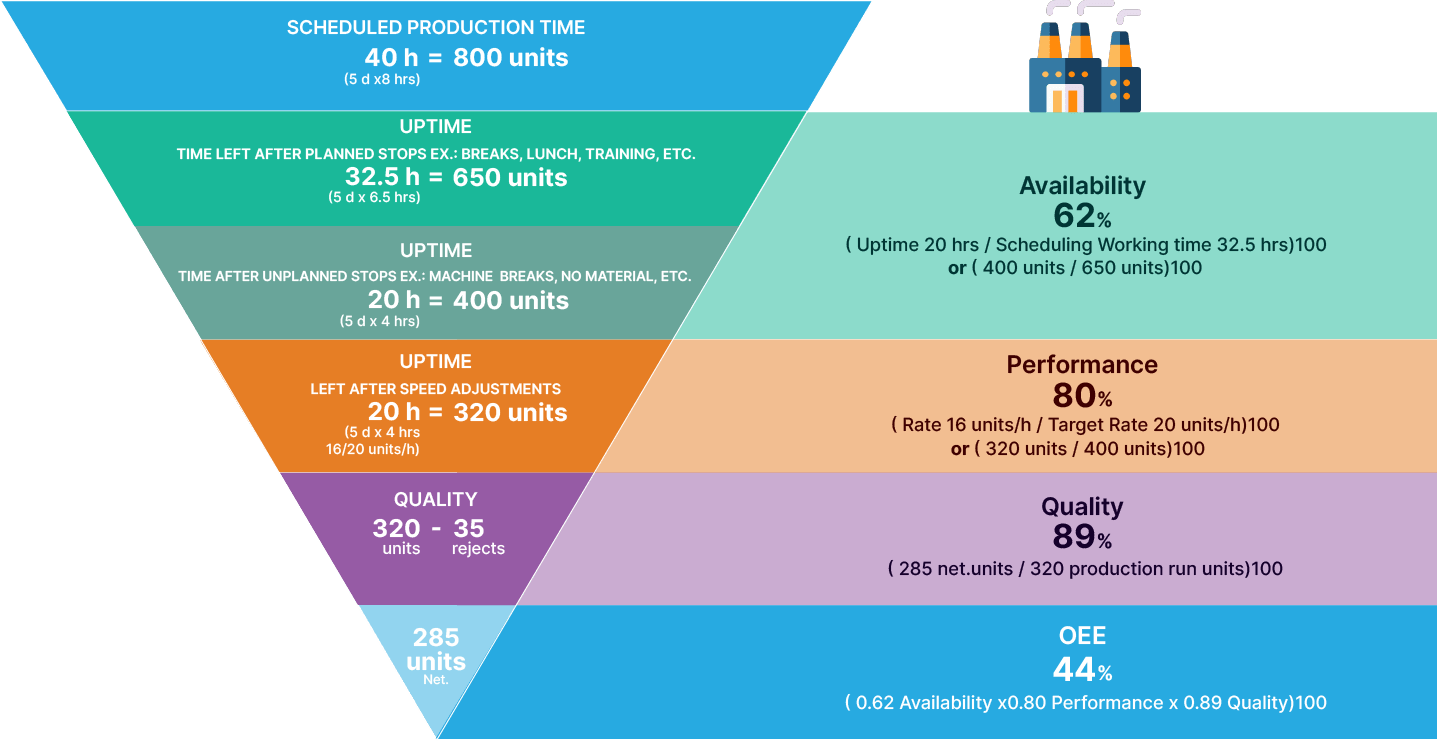
nfographic illustrating the major sources of Overall Equipment Effectiveness (OEE) losses in manufacturing, showing categories such as downtime, speed losses, and quality losses that impact production performance and operational efficiency.
15
Nov 2023

Decoding the OEE Calculation: Translating OEE Metrics into Tangible Losses

The following OEE funnel is a great way to visualize how losses in availability, performance, and quality impact OEE and your throughput.

English