25/7/18

5 Key Advantages of Monitoring Yield in Food & Beverage Manufacturing

By monitoring yield & using combination of "time-honoured methods" and statistical analysis on a repeatable basis, it's possible to make a 25% improvement in yield in the food and beverage manufacturing."

Analytics
Food Manufacturing IIoT
Industry 4.0
Machine Monitoring
Smart Factory
5 Key Advantages of Monitoring Yield in Food & Beverage Manufacturing

It's possible to make a 25% improvement in yield in the food and beverage manufacturing by monitoring and using a combination of "time-honoured methods" and statistical analysis on a repeatable basis, according to the writers of the article, "Uncovering New Ways to Improve Yield in Food & Beverage Production." 

  
The authors say, "Huge gains in yield have been achieved through Lean Manufacturing, Six Sigma and Kaizen — so much that it may seem no more can be done, particularly in the waste-intensive, fast-paced food and beverage industry." Yet, the two case studies they carried out and which they based the article on, indicate otherwise.
 

Introducing... Five key advantages to monitoring yield 


  1. Develop a shorter problem-solving cycle: Bigger improvements in weeks, not months
  2. Engage deeper deployment of process-improvement skills and tools
  3. Gain a wider embrace of continuous improvement philosophy by your production team
  4. Increase sustainability of results over time: Ongoing improvements can be made beyond one-off or single projects
  5. Establish a shortened production time: Decrease time-frame from defining a problem to controlling and improving the outcome from several months to several weeks. 


By monitoring yield and adopting these "powerful new processes [companies] can dramatically improve their margins," the authors write, "companies can dramatically improve their margins."  "It’s essential to find ways to ensure that you hold onto those gains through ongoing engagement and standardization of best practices."

Source + read the entire article



Want to learn more?
Download the ebook
Related blog articles

Related articles

Back to the blog
Thank you! Your submission has been received!
Oops! Something went wrong while submitting the form.
7
Jan 2019

Artificial Intelligence in the Food Industry: Six areas of application

English
10
Sep 2019

Types of waste in lean production — waste from manufacturing defects

English
12
Apr 2018

Smart Factory Analytics: Creating New Business Opportunities

English

Related articles

Back to the blog
Thank you! Your submission has been received!
Oops! Something went wrong while submitting the form.
Hand interacting with a futuristic digital interface displaying “2024,” AI icons, and technology symbols, representing emerging technology trends, artificial intelligence, digital transformation, innovation, and future-focused business strategy.
9
Jan 2024

Manufacturing Trends to Lookout for in 2024

As we look at manufacturing trends for 2024, pressure to stay on top of current trends and maintain competitiveness are at an all-time high

English
Automated bottling and packaging line in a manufacturing facility, with glass bottles moving through production equipment, representing production throughput, manufacturing output, operational efficiency, and process performance.
5
Dec 2023

Understanding takt time in manufacturing

Through real examples and practical insights, discover why measuring and monitoring takt time is the path to optimized production.

English
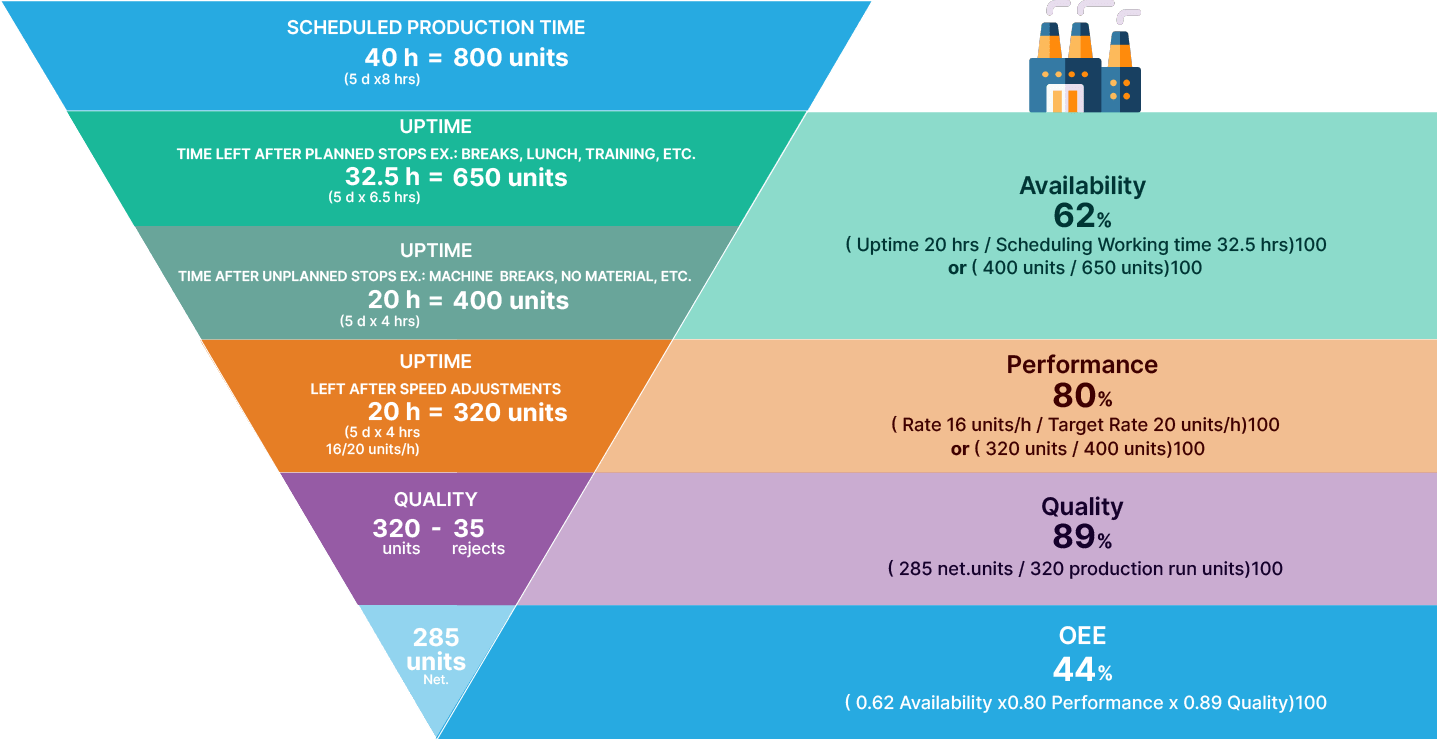
nfographic illustrating the major sources of Overall Equipment Effectiveness (OEE) losses in manufacturing, showing categories such as downtime, speed losses, and quality losses that impact production performance and operational efficiency.
15
Nov 2023

Decoding the OEE Calculation: Translating OEE Metrics into Tangible Losses

The following OEE funnel is a great way to visualize how losses in availability, performance, and quality impact OEE and your throughput.

English