28 May
2018

How to use OEE in smart manufacturing

The OEE calculation rolls the “6 big losses” of TPM into one number that represents the effective operating rate for a piece of equipment or synchronized line—in other words, the percent of time the equipment or line is operating effectively, or its valuable operating time.

Lean Manufacturing
How to use OEE in smart manufacturing

An article on the Industry Week's website OEE - Learn How to Use It Right clearly explains what is Overall Equipment Effectiveness and how to use it.

"Put simply, OEE assigns numerical value to improvement opportunity. It factors in the availability, performance and quality of output of a given piece of equipment and tells you this:

How much right-first-time product did this machine produce
compared to what it should have produced
in the allocated time?

In other words, is a piece of equipment effective within its value stream? Does it let you meet present or future customer demand? If not (and this is critical), OEE helps you analyze the reasons why so you can address them systematically."

How is OEE calculated

OEE (%) = Availability rate × Performance rate × Quality rate

Availability rate (percentage of time the machine is ready to produce, working properly, and not in the midst of changeovers or adjustments) = Available time (scheduled operating time − downtime) ÷ Scheduled operating time.

Performance rate (ratio of output produced compared to a standard) = Actual output ÷ Standard output.

Quality rate (ratio of good output compared to actual output)= Right-first-time output ÷ Actual output.

How to Use OEE 

The author of the article in Industry Week  highlights 4 key uses:

  1. Use OEE as an improvement metric.
  2. OEE is best used on a single piece of equipment or synchronized line.
  3. There is no absolute that works as an OEE benchmark or target – it’s relative to your situation.
  4. As a Yardstick for measuring improvement

Start Monitoring your OEE today

Worximity now offers new Overall Equipment Effectiveness add-on for Smart Factory Level 3.
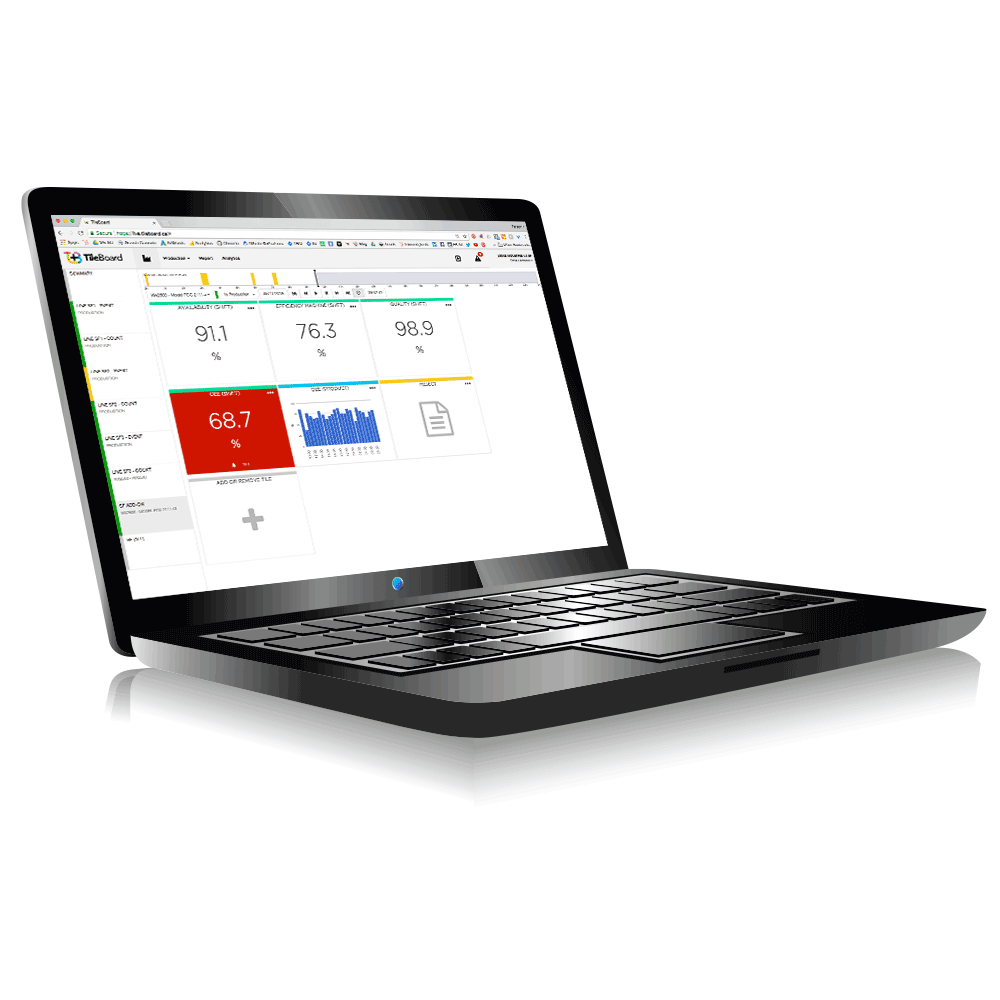
Worximity_PC_OEE_alert

SOURCE: http://www.industryweek.com/quality/oee-learn-how-use-it-right

Want to learn more?
Download the ebook
Related blog articles

Related articles

Back to the blog
Thank you! Your submission has been received!
Oops! Something went wrong while submitting the form.
23
May 2024

Exemples de Lean Manufacturing provenant des principaux leaders de l’industrie

French
9
Jan 2024

Manufacturing Trends to Lookout for in 2024

English
16
Oct 2023

The Synergy Between Lean Manufacturing and OEE Monitoring

English

Related articles

Back to the blog
Thank you! Your submission has been received!
Oops! Something went wrong while submitting the form.
29
Oct 2019

On-Premise vs. Cloud Manufacturing Software - An Important Decision

When selecting a manufacturing software solution, an important decision is whether to go on-premise or SaaS. Pros and Cons here.

English
21
Aug 2018

Qui devrait monitorer la surproduction sur ses lignes de production?

Êtes-vous un manufacturier qui gagnerait à monitorer sa surproduction en temps réel? Si vous emballez des produits à poids fixes et que vous souhaitez réduire les coûts de matières premières et de main d'oeuvre tout en accroissant la capacité de votre usine, la suite Giveaway de TileBoard est faite pour vous.

French
17
Aug 2018

Que doit contenir un tableau de bord pour monitorer la surproduction?

Réduissez la surproduction ou le giveaway en monitoring en temps réel les produits en cours de fabrication grâce à l'application tableau de bord TileBoard qui vous permet de réduire les pertes de matières premières, d'améliorer la capacité et d'optimiser le temps de la main d'oeuvre.

French