
Harvard Business Review has published an article: "The 5 Things Your AI Unit Needs to Do" which presents 5 most successful initiatives to start your shift to AI.
According to the European Center for Strategic Innovation (ECSI), which has surveyed the most successful companies in their implementation of AI units, the first steps to take are:
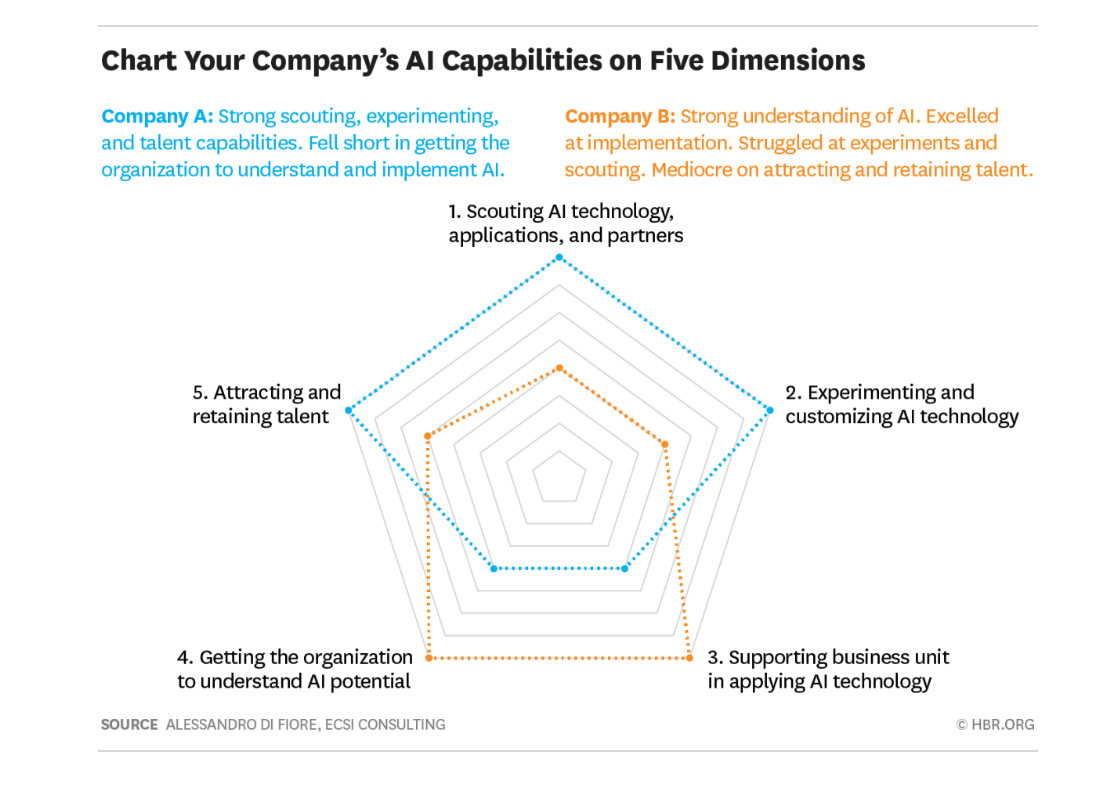
- Scouting AI technology, applications, and partners. Companies must have in-house AI hunters who will identify innovations, key players and emerging companies that may become partners.
- Experimenting with AI technology and applications. By undertaking pilot projects that adapt well to the company's concrete projects, it is possible to quickly determine the best approach to implement. These can be AI initiatives developed by an internal team or partnerships with startups that have innovations adapted to the reality of the company
- Supporting business units in applying AI technology. The goal of integrating AI into an organization is to align it perfectly with business and business models. Teams of data scientists must work closely with operators to ensure that the developed AI contributes to the better turnover of operations.
- Getting the entire organization to understand AI. For the power of artificial intelligence to be fully expressed, AI leaders of the company must educate the entire team to be part of this shift. Employees need to understand the value of AI and leaders must ensure to keep the exchanges simple and concrete so as not to dull the interest of their colleagues whom might be less experienced. To do so, the company oughts to take a stand on the issue of artificial intelligence and clearly communicate its orientations to its troops. The human resources department has to address the issue of training and updating skills to ensure that teams are equipped for the AI shift.
- Attracting and retaining talent. Some companies will make business acquisitions with AI expertise that is perfectly suited to their field, while others will set up an internal IA department and recruit new talent and offer training to their employees who wish to develop their potential. in this avenue. The competition will be fierce with the massive rise of AI and the positioning of Montreal as a global AI pole.
HBR suggests that each organization or AI-driven team should position themselves on this spider-graph based on their context, goals and constraints.
To read HBR's full article on the topic, click here.

Related blog articles