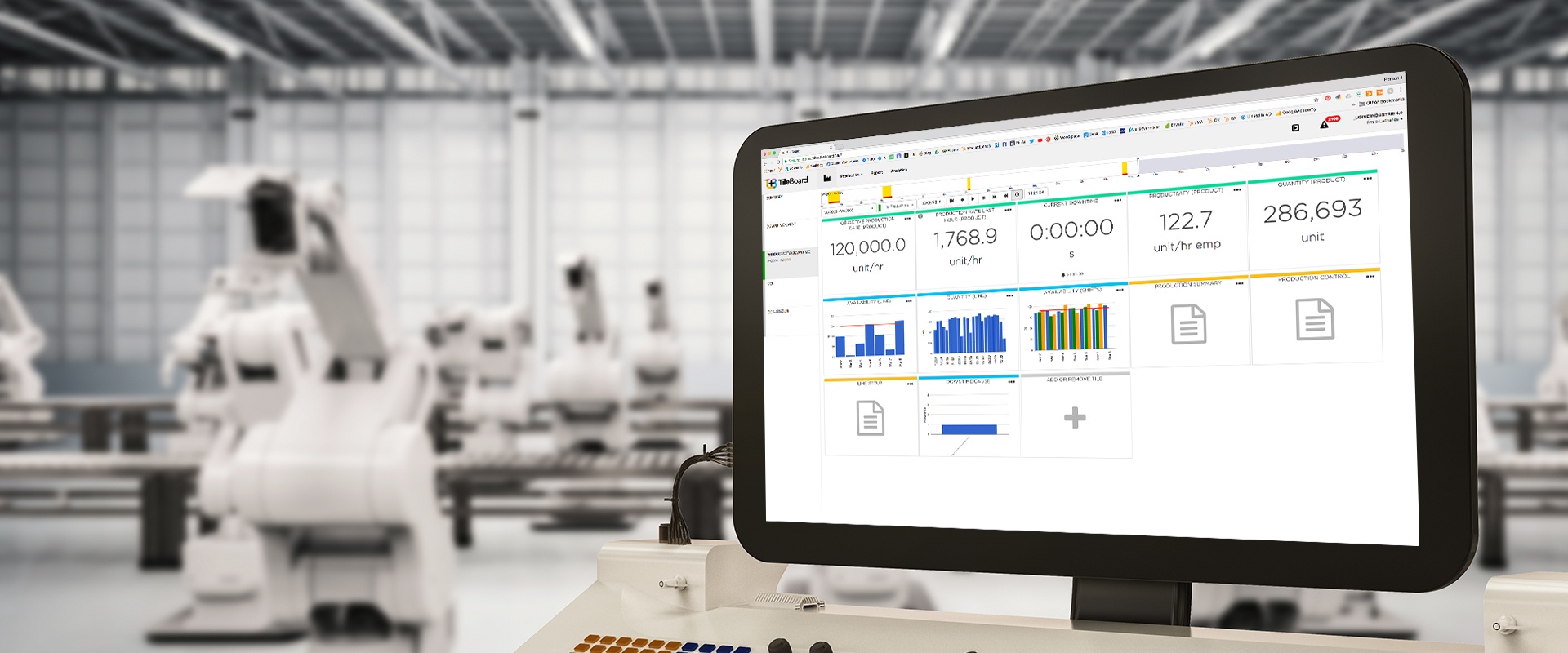
Measuring overall equipment effectiveness (OEE) is crucial to maximizing factory efficiency, so we tend to discuss it frequently. OEE reveals the financial impact of improvements, in addition to evaluating production performance.
How to Calculate OEE
OEE = Availability x Performance x Quality
Looking at a formula is one thing—applying it is another. The best way to truly understand how to calculate OEE is with a good example. The following OEE calculation example will help you understand how to apply it to your situation.
What Factors to Consider
We know that determining OEE requires three factors—here’s what they mean:
• Availability: Run time or planned production time
• Performance: Actual cycle time or ideal cycle time
• Quality: Good products or total products produced
If you’re wondering how this formula works in a real factory, the following is a good example.
Calculating the OEE of an Electronic Company’s Production Plant
Let’s use an electronic company’s production plant with the following schedule:
• The company is open for 14 hours every day.
• The manufacturing plant operates for 10 hours a day 20 days a month.
Availability: Calculating Planned Production Time
Our planned production time is 200 hours a month because this is how much we plan to keep the equipment running.
However, each workday, operators take a half-hour lunch break, two hours of maintenance is planned each month, and equipment breaks down for an average of three hours per month.
This gives us a total of 15 hours of downtime per month:
• 10 hours of lunch breaks,
• two hours of maintenance and
• three hours of equipment failure.
15 hours / 200 hours = 7.5% → 100% - 7.5% = 92.5% availability = 185 hours of actual run time
Performance: Calculating Cycle Time
Our equipment could ideally complete 60 cycles per minute. However, it performed only 52 cycles each minute in the past month.
52 cpm / 60 cpm = 86.6% performance
Quality: Accounting for Rejects
It takes 50 cycles to produce any electronic; therefore, our production plant is producing roughly 62 electronics each hour.
52 cpm × 60 minutes = 3120 cycles per hour
3120 cycles / 50 cycles per electronic = 62 electronics/hour
Multiplying that by 185 run time hours per month, we get a total production of 11,470 electronics per month. However, only 10,950 of these electronics are good.
This means we have a quality score of 95.5%
10,950 / 11,470
In summary, the equipment is:
• available 92.5 percent of the time,
• its performance is 86.6 percent effective,
• and product quality is at 95.5 percent
Let’s Calculate OEE
Using the above numbers, the plant's overall equipment effectiveness equates to 76.5%:
OEE= 92.5% x 86.6% x 95.5% = 76.5%
While individual metrics for each input appear to be relatively high, it is evident that their collective impact can significantly downgrade the overall efficiency of the plant when calculating OEE.
The question we then need to ask ourselves is how good or bad is an OEE score of 76.5 percent? For many manufacturers, it could be sufficient, or at least a good benchmark. General OEE industry standards are as follows:
• 100%: Perfect
• 85%: World-class level, and often a goal for discrete manufacturers
• 60%: Typical, but with clear room for improvement
• 40%: Low, but typical for factories that are measuring OEE for the first time
Using Smart Factory Technology and OEE Software to Improve Productivity
Smart factory technology is crucial for those who want to calculate an accurate OEE and know if each process is maximally productive. Using smart factory features such as automated data collection, real-time dashboards, and analytics reporting, managers can determine things like:
• If small stops are becoming a significant issue.
• What is causing slow cycles and speed loss.
• How well workers are following processes.
• What planned and unplanned downtime look like.
Find Out How to Calculate OEE for Your Plant
Take control of your plant's effectiveness with Worximity’s Smart Factory technology. Empower you and your team to improve performance by uncovering hidden capacity and boosting production.
Not sure where to start? Try our OEE calculator.