5 Jun
2018

Visualize the uses of AI and analytics with this interactive tool

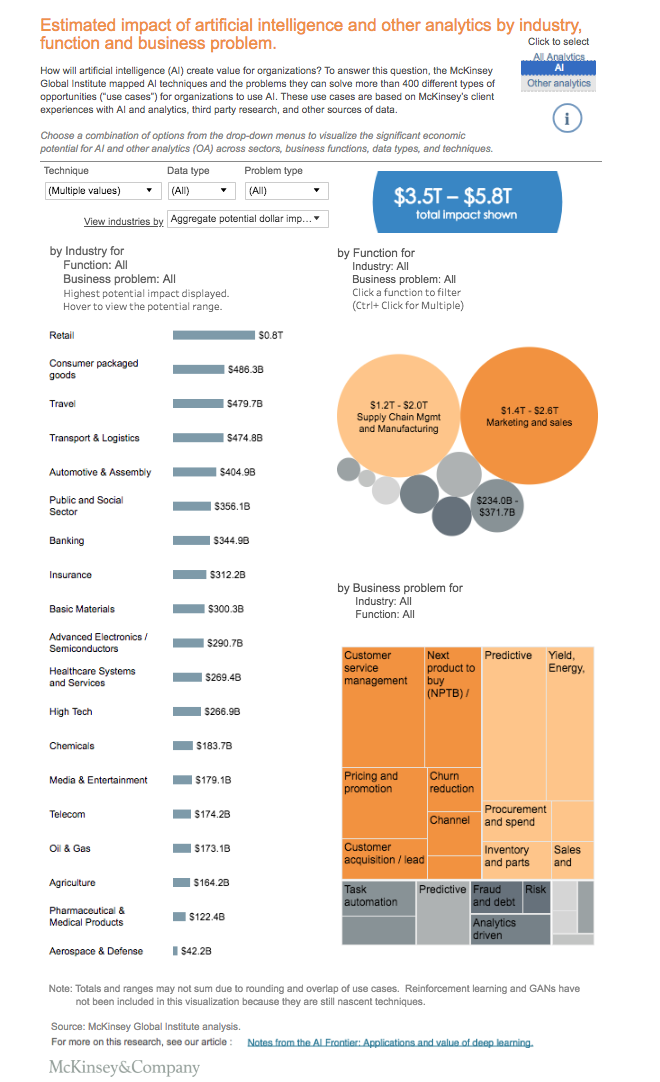
McKinsey's interactive data visualization shows the potential value created by artificial intelligence and other analytics techniques for 19 industries and nine business functions.

Artificial Intelligence
Visualiser les utilisations de l'IA et de l'analytique avec cet outil interactif

McKinsey published this interactive tool to help people understand the uses and impacts of artificial intelligence and analytics.  It is based on a study of more than 400 use cases, covering 19 industries and nine business functions.

Play with the Technique, Data Type and Problem Type to visualize the impact.
McKinsey_Visualization_tool

SOURCE: https://www.mckinsey.com/featured-insights/artificial-intelligence/visualizing-the-uses-and-potential-impact-of-ai-and-other-analytics


Want to learn more?
Download the ebook
Related blog articles

Articles connexes

Retour au blog
Nous vous remercions ! Votre demande a bien été reçue !
Oups ! Un problème s'est produit lors de l'envoi du formulaire.
26
Avril 2019

Les robots et l'intelligence artificielle font leur entrée dans l'industrie alimentaire

French
7
Janvier 2019

Artificial Intelligence in the Food Industry: Six areas of application

English
8
Oct 2019

Types de gaspillages dans le lean manufacturing - le gaspillage dû au sur-traitement

French

Articles connexes

Retour au blog
Nous vous remercions ! Votre demande a bien été reçue !
Oups ! Un problème s'est produit lors de l'envoi du formulaire.
15
Avril 2024

Top Continuous Improvement Tools for Food and Beverage Manufacturers

Food and beverage manufacturers face increased demand and supply chain shortages. Continuous improvement tools can help you keep customers and remain profitable.

English
9
Juin 2021

How to Transform Your Continuous Improvement Plan from Paper to Digital

Find out how your continuous improvement plan can benefit from going from paper to digital.

English
6
septembre 2018

What is OEE? - Overall Equipment Effectiveness

In the OEE system, a score of 100% represents the theoretical best output (no faulty parts, maximum possible speed, no stops), and a score of 0% represents a total shutdown (any metric being 0% during production time). In real life an OEE score of 100% is obviously impossible, but carefully measuring a current process against its ideal form is a necessary to understanding where improvements can be made.

English